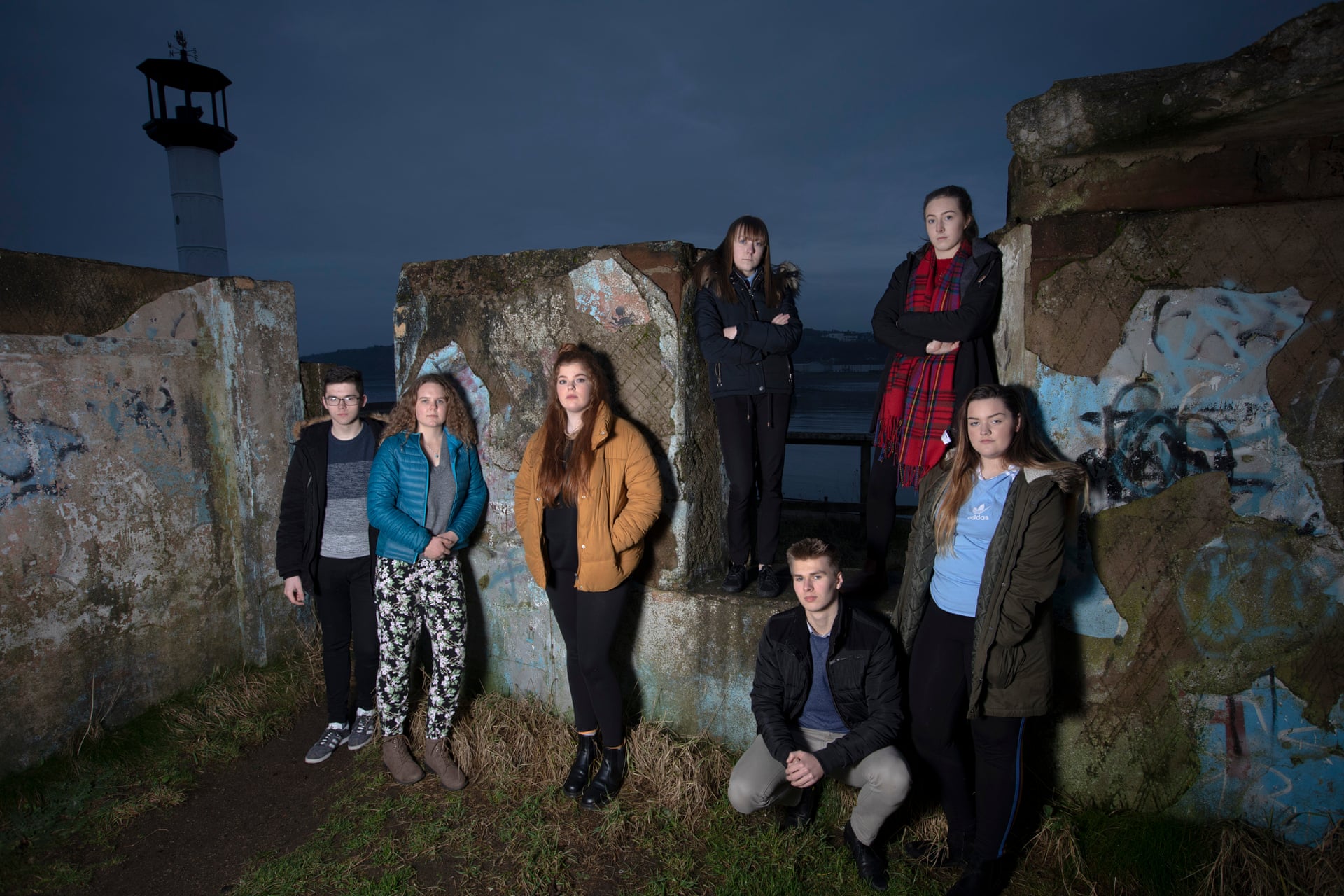
With conventional services overstretched, teenagers in the Cumbria coastal town of Maryport teamed up to assist their peers
Last year, Molly Robinson, 15, was struggling to cope with the symptoms caused by an undiagnosed health condition. The unexplained pain, plus the worry about what was wrong, caused her to feel increasingly anxious and distressed. She plucked up the courage to seek help. And what happened? “I was put on a waiting list.”
Over the next three months things just got worse until she began to feel “completely overwhelmed”. “Everything snowballed,” says Molly. At crisis point, she couldn’t cope with going to school. “It took that for anyone to take things seriously,” she adds.
Frustrated by the waiting times for mental health services, Robinson talked to some friends she had met while local people were protesting to save beds at their cottage hospital. They decided to form a group, We Will, to campaign for more understanding and skilled support for young people suffering mental ill health.
In a community centre on the Ewanrigg estate in Maryport one Thursday afternoon, seven well-informed young people explain why they have worked so hard over the past year to improve their own and their community’s skills in supporting people with mental health problems.
The causes sound familiar. All cite the seemingly constant requirement to do well in exams, and the intense, addictive buzz of social media as pressures that older generations never had to deal with. “It’s very different being a teenager now,” says Chloe Wilson, 17. “Especially parents; they want their child to be fine. They’ll say, ‘Oh, it’s just hormones’.”
Hanah Pantling, 18, agrees. “The older generation say ‘suck it up’. We’re told to just get on with it. Especially lads round here – they’ve got that rugby attitude: can’t shed a tear, just man up.”
Jasmine Dean, 17, tells of the shock of hearing a friend talk about suicide. Saying she’s “angry” at the delays some young people have to endure when trying to get support for mental health problems, Dean asks: “How is being in crisis with a mental health issue any different from being in crisis with a physical issue?”
“People don’t want to stare it in the face – the lack of resources to help this generation,” says 17-year-old Billy Robinson. He isn’t just relying on anecdotal evidence: the We Will group has done its research. Over a year ago, the government issued a green paper proposing to put £300m into extra mental health provision in schools – but the new support envisaged will not be available until an unspecified time in the 2020s. Meanwhile, while children’s suicide rates are up 67% since 2010, a quarter of those referred for help are denied treatment. Despite the need, according to the Care Quality Commission, 23% of child and adolescent mental health services (Camhs) are rated “inadequate” or “requires improvement”.
The group of teens knew they would need help to plan and organise their campaign, so a year ago they approached Kate Whitmarsh, development worker at the community group Ewanrigg Big Local, which has a mandate to grow grassroots initiatives proposed by anyone resident in the area.
“It’s tough growing up here on the western edge of Cumbria,” says Whitmarsh. “This isn’t the affluent Lake District: lots of young people live in rural deprivation.” Child poverty rates are high, she says, public services are stretched, health stats are shocking and work prospects are limited.
Whitmarsh has encouraged the We Will teenagers to get trained up in the skills required to offer their peer group emotional support without feeling scared or overwhelmed, themselves. She has mentored them as they embarked on lobbying their MP, making their own eloquent film, persuading Maryport businesses to display mental health awareness posters, doing media interviews – and finally, plucking up the courage to approach their schools’ senior leadership teams to take action.
At Cockermouth school the next morning, Tom Roberts, 18, explains how – championed by school governor Alan Rankin, who works in human resources at Sellafield, – three of them met their school leaders armed with almost 20 ideas. The students hoped the school top brass might agree to a few of their suggestions. “But they said, ‘If you want, you can do all of them’,” Roberts recalls with a laugh. “Then we had to make it happen!”
Assistant head Steve Milledge grins at him. “You taught us a lot about how to do this with a really student-centred approach,” he says.
One of the results of the students’ campaign is that 80 pupils and staff at Cockermouth school have completed a mental health first aid course. Participants are trained to listen and acknowledge that someone is in emotional pain, but – crucially for teenagers who may feel panicked – they are helped to grasp that they are not personally responsible for fixing anyone’s problems.
While Ewanrigg Big Local has funded this training at Cockermouth and other secondaries in the area, Milledge says the next step is for his school to train its own trainer, and offer the course to governors and parents. This will be a significant investment at a time when school budgets are stretched to breaking point. How can Cockermouth school afford it?
“My argument is: how can we afford not to?” says Milledge. “Thresholds for Camhs are getting higher. There’s been an increase in the number of children talking about suicide. Without a counsellor, there are children who wouldn’t be able to be in school. A culture of listening and being listened to is really important in people feeling well and healthy.”
Jo Hampson, a counsellor employed by Cockermouth school, says the need is urgent. Even when children are referred to Camhs, she says, nothing happens. “It’s dreadful, appalling. When I started here children’s services had two workers supporting families. At one point the mental health team could be seen within 48 hours. Now, we’ve got children who would once have been emergency cases waiting for months. Family workers don’t exist any more. Children’s services?” She shrugs. “You might as well talk to the wall.”
Camhs in west Cumbria says it meets its targets for seeing young people in crisis within 48 hours “and often on the day”. In line with the national picture, it has seen an increase in referrals and demand for services that has impacted on waiting times – 230 children are currently on the waiting list.
The We Will teens know they can’t fix the national gap in mental health services for their age group, but they are using their knowledge, energy and fury to highlight the urgency of the need.
They want Maryport to be designated a mental health first aid town, with local employers encouraging their staff to do mental health first aid training, and all schools to have a governor responsible for mental wellbeing and a programme of mental health first aid training for older pupils and key staff. Teacher training is also in their sights. “We think it should include training about young people’s mental health,” says We Will member Lucy Steel, 15.
Billy Robinson points to the recent call by the children’s commissioner for England, Anne Longford, for the government to fund a counsellor in every school. This, he urges, should be adopted without delay. “Every year you wait,” he says, “thousands of young people will suffer.”